
Chariton County Civil Docket Searches
Missouri Case.net is where a Chariton County civil docket search actually happens. The county itself runs no separate case-search portal. Case.net lets you search by name, case number, filing date, or scheduled hearing. The tightest identifier wins. A full case number is the surest match. Without one, type the party name. Pick Chariton County or the Ninth Judicial Circuit when the form offers a court selector.
Before trusting a hit, confirm the court location, case category, division, filing date, and each party's role. Case.net is an index and docket viewer, nothing more. Many pleadings, exhibits, and older papers simply are not posted there. The Chariton County Circuit Clerk keeps the official docket sheets and case records. Request any civil judgment or document you need to rely on from that office.
Match on division and party role, not on a shared surname alone.
- Open the official Case.net entry and choose Case Number Search, Litigant Name Search, Filing Date Search, or Scheduled Hearings & Trials.
- Select Chariton County or the Ninth Judicial Circuit location when available, then enter the most precise public information.
- Open the result that matches the civil category, court, division, date, and party role.
- Read Case Header, Docket Entries, Scheduled Hearings & Trials, Civil Judgments, and Garnishments or Execution when those tabs are shown.
- Ask the Circuit Clerk for public-terminal access, a plain copy, or a certified copy when the online docket does not provide the needed record.
Chariton County Civil Docket Divisions
The Chariton County Circuit Court sits inside Missouri's Ninth Judicial Circuit, one unified system with several divisions. A Chariton County civil docket is not a single bucket. Circuit civil takes full-jurisdiction matters. Associate civil handles the limited ones. Small Claims stands apart under Chapter 482. Probate covers estates, guardianships, and conservatorships. Family and domestic-relations files may carry their own code and tighter access. The division and case suffix tell you more than a vague label like "civil case" ever will.
| Chariton County civil division | Public docket context | Primary record route |
|---|---|---|
| Circuit Civil | Full-jurisdiction civil matters and related filings | Case.net, then Circuit Clerk |
| Associate Civil | Limited civil matters and other associate-division civil work | Case.net, then Circuit Clerk |
| Small Claims | Chapter 482 complaints, service, hearings, judgments, and appeals | Case.net where public; clerk for file records |
| Probate | Estates, guardianships, conservatorships, and related records | Case.net subject to document rules; clerk confirmation |
The Ninth Judicial Circuit local rules name the divisions outright: Circuit, Associate, Probate, Juvenile, Small Claims, and Municipal. That structure matters when a Chariton County civil docket search returns near-identical category names and you need to tell them apart.
Note: The division label is a practical search clue when a case description does not say whether it is circuit, associate, or small claims.
Civil Dockets: What They Show
A Chariton County civil docket is a dated timeline of court activity. Case Header, Parties & Attorneys, Docket Entries, Service Information, Filings Due, Scheduled Hearings & Trials, and Civil Judgments are tabs you may see on Case.net. Garnishments or Execution can round out the list. An entry can record a filing or an order. It may also list a petition, summons, return, answer, motion, affidavit, default, dismissal, nonsuit, judgment, satisfaction, garnishment, execution, or appeal. Remember that the register shows dates and events. It is not a stand-in for reading the filed documents themselves.
| Case number | The court identifier. Civil records commonly use CV with a sub-code such as AC for associate civil or CC for circuit civil. |
|---|---|
| Parties | The public people, businesses, or government entities listed as plaintiff, defendant, petitioner, respondent, or another role. |
| Initial filings | Public docket references to a petition or complaint, summons, and return of service where available. |
| Motions and orders | Dated requests to the court and the judge's public action on them. |
| Setting | A scheduled court event that should be read with the newest entry and court notice. |
| Judgment data | Public judgment, dismissal, nonsuit, satisfaction, garnishment, or execution information when applicable. |
A docket entry is procedural information. Read it alongside the case category, the disposition, and any operative order the file contains. A party can file something that is later denied, dismissed, restricted, or superseded. Does the exact wording of an entry matter? The Chariton County Circuit Clerk can tell you how to get the public copy.
Chariton County Civil Docket Codes
Missouri Court Operating Rule 4 builds the record-keeping and case-number framework. That framework sits behind every Chariton County civil docket. Each uniform number carries a filing year, a location, and a two-letter category. A sequence and a sub-case code complete it. Civil codes include CV, plus DR for domestic relations, SC for small claims, P for probate, AC for associate civil, and CC for circuit civil. The code alone never decides access. It does tell you the division and what kind of court record you are viewing.
The official Court Operating Rule 4 text lays out that statewide structure. It treats the docket sheet and filed documents as parts of the official record, subject to the rules protecting confidential material.
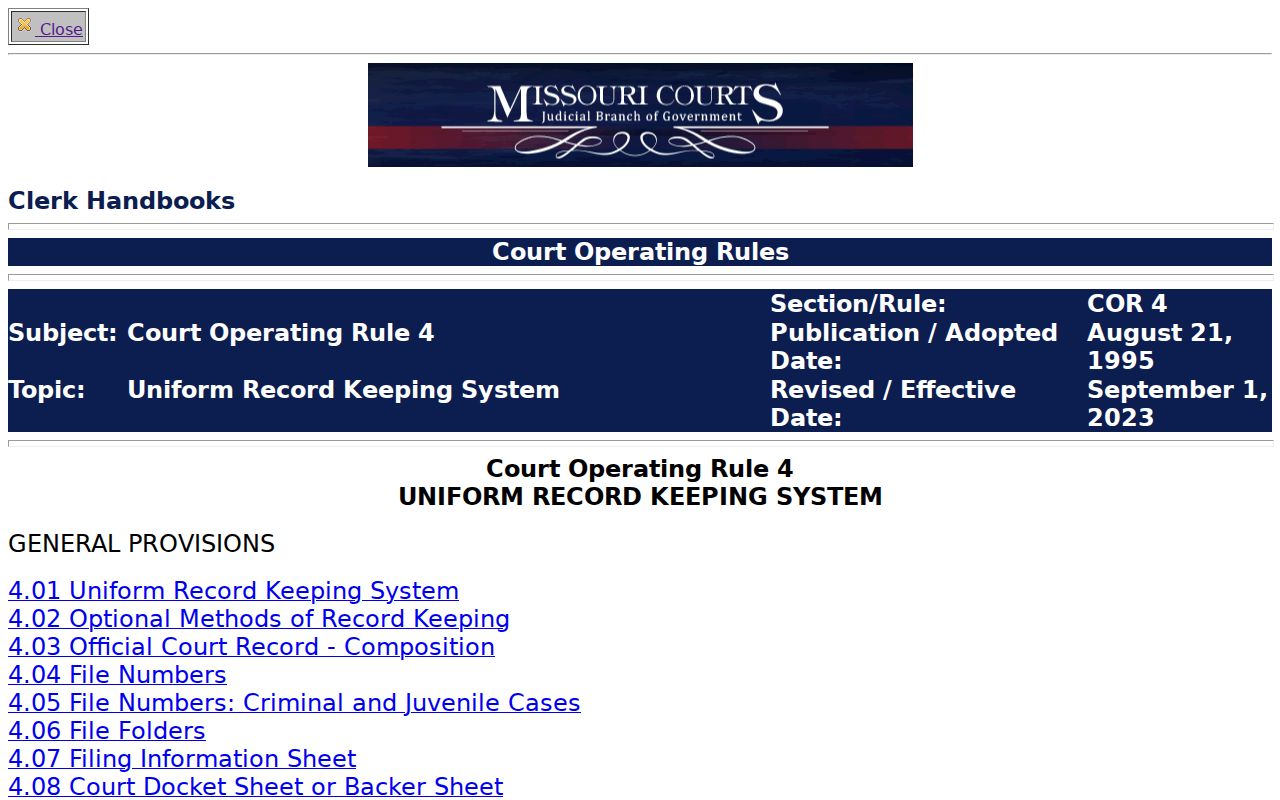
The rule explains the shared Missouri numbering system without exposing any private case record.
- Service
- The process of delivering the summons or other court papers, often reflected by a return entry.
- Default judgment
- A judgment that can be entered when a party does not respond or appear as required.
- Nonsuit
- A civil termination initiated by the plaintiff without a merits judgment, subject to applicable law.
- DWOP
- Short for dismissal for want of prosecution; verify the full local docket text.
- Execution
- A post-judgment process that can appear in the public docket after judgment.
What Cases Fill the Civil Docket
Civil court work in Chariton County comes in several forms. Circuit civil and associate civil are distinct categories, not one stack. The local rules set the split. Limited civil matters, unlawful detainer, rent and possession, and small claims sit under associate jurisdiction. Probate holds estates, guardianships, and conservatorships. Domestic-relations records can include protected addresses, financial statements, parenting details, and social reports. A docket category routes your search. It never guarantees that every document in the file is open to the public.
- Circuit civil matters, including public petitions, motions, orders, judgments, and appeals.
- Associate civil matters, including the limited civil categories assigned by Missouri law and local rules.
- Small claims cases, which can show complaint, service, answer, continuance, trial, judgment, satisfaction, or appeal entries.
- Rent-and-possession and unlawful-detainer matters handled in the appropriate associate civil route.
- Probate matters such as estates, guardianships, and conservatorships, subject to document-specific access rules.
Juvenile matters are different. The unified court system has a Juvenile Division. Those files face stronger access restrictions than an ordinary civil docket. If a Chariton County result carries a family, juvenile, or protected category, ask the clerk what is public rather than guessing at restricted content.
Note: A category helps route the search, yet access to any specific document still depends on the court rule governing it.
Chariton County Civil Docket Service
Every civil case on the Chariton County docket starts with a filing. The petition or complaint opens the public record. Service comes next. A summons and its return show whether service activity was recorded. After that, the docket may list an answer, a motion, or another filing. Case.net lists entries in order. The run of entries hints at what a future setting concerns, whether service, a motion, a trial, or post-judgment work. It still cannot settle a disputed legal question; only the actual filing or order can do that.
Document links work differently. Per Case.net File Viewer help, a hyperlinked docket entry means an attached document is available to the viewer. An entry with no link may have no attachment at all. Or access may be limited. ECASE marks a court file kept electronically rather than on paper. Need an older file, a missing online document, or an official judgment copy? The Chariton County Circuit Clerk is the local public-records channel.
Hearings on the Civil Docket
Hearing details for Chariton County civil cases appear in two places on Case.net: Scheduled Hearings & Trials and the newest Docket Entries. Settings vary widely. A case might carry a motion hearing, a status or review hearing, a bench trial, a jury trial, or another kind of court date. The public calendar search asks for a court location, a start date, a judge or attorney, and either a Single Day or Seven Day period. That search is a strong way to find public hearing information. Still, the sequence that controls is the current notice or order first. Then comes the latest docket entry. Then comes confirmation from the clerk or the court.
A continuance or reset shifts a date. It normally shows up as a later docket event. So an earlier setting that was completed or vacated is not the current one. Under the Ninth Circuit local rules, Circuit Division I sessions in Chariton and Linn begin at 9 a.m. unless otherwise ordered. That rule does not fix the hour for every civil hearing. Before an upcoming matter, compare the Case.net record with the court notice. Call the Circuit Clerk if the two conflict.
Chariton County posts no separate daily civil docket PDF and no public courtroom directory in its official materials. Use the calendar search instead.
Chariton County Civil Docket Settings
A civil setting is a court date, not a judgment. A motion hearing takes up a request made to the court. A judge alone decides a bench trial. A jury decides disputed facts at a jury trial. A status or review hearing simply checks case progress. The docket may instead show a dismissal docket or an inactive-case step. Reading the setting type beside the case category explains why a Chariton County civil docket lists a date. It does not assume the case is resolved.
| Public civil docket field | What it helps confirm |
|---|---|
| Case number and division | Whether the search result belongs to the correct Chariton County civil route. |
| Newest Docket Entry | Whether a setting was created, completed, continued, or vacated. |
| Scheduled Hearings & Trials | Public future date, time, court, and setting information where available. |
| Order or judgment link | Whether a public document is available to read beyond the docket text. |
Have the case number but no future date? Look for a later docket event first. Then contact the Circuit Clerk, who can explain record availability and copy procedure, though the office cannot give legal advice about the civil dispute.
Who Can See Civil Dockets
Much of a Chariton County civil docket is public through Case.net: case headers, parties and roles, filing dates, docket entries, settings, public judgments, and document links subject to security rules. Access is document-specific as well as case-specific. Probate files can hold financial and medical information. Family records may contain protected addresses, financial statements, parenting information, and social reports. Juvenile records face stronger restrictions. A public case header never makes every document in the file public.
Chariton County civil access rules:
Court Operating Rule 4 establishes the uniform automated record system and public-access equipment, subject to confidentiality.
RSMo § 610.023 sets a custodian and prompt-response framework for public-record requests.
RSMo § 211.321 generally makes juvenile proceedings and related records confidential except for statutory exceptions.
Missouri draws its access line in one place. The official Missouri Supreme Court Rule 122 source sets out what the public may see. It matters most at the boundary between ordinary public civil records and restricted juvenile or family material in the unified court system.
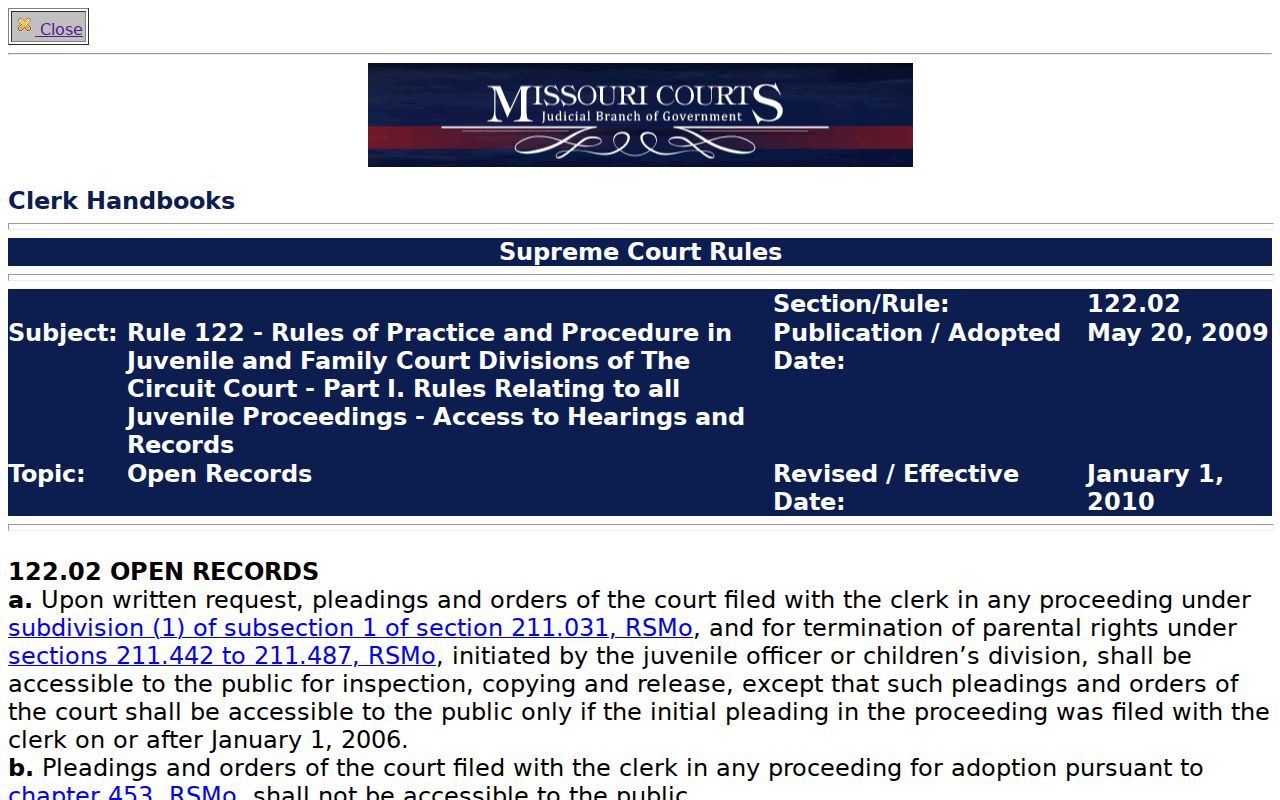
Rule 122 is worth a careful read during any Chariton County civil docket search. It flags when a familiar case type carries restricted records.
Chariton County Civil Docket Document Access
When a public docket points to a document you need, start with the entry itself. Is it linked in Case.net? If not, two documented channels remain: the courthouse public terminal and the Circuit Clerk. The Chariton County courthouse contact page posts the courthouse public-hours block. The clerk sits at 306 S. Cherry Street in Keytesville. The clerk can be reached at 660-288-3602. A request should give the Chariton County case number, the division if known, and the filing year. Add a description of the document. Say whether a plain or certified copy is needed. The county has posted no dedicated online order form or civil-copy fee schedule.
Juvenile files are different. The official RSMo § 211.321 source covers juvenile confidentiality, a critical Chariton County civil docket boundary. When a record is restricted, neither the public terminal nor a general public-record request changes the rule. That rule controls access.
That statute separates two very different requests. One is a public civil docket lookup; the other seeks material Missouri law keeps confidential. A Chariton County public-record request cannot override the confidentiality rule that protects a juvenile or otherwise protected court file.